|
| The Dark Souls of the Super Nintendo! |
If you've ever heard anyone talk about The 7th Saga, or if you've ever read or watched someone's review of the game, then chances are that they're going to be
extremely negative about the game. To be honest, they're right. This game
does suck. Even to me, who likes it based on nostalgia alone, I think it sucks, too. But why does it suck so much, you ask? Well, I'm going to tell you.
Released all the way back in the U.S.A. in 1993 (one year after I was born, God I feel old), The 7th Saga sees the player pick one of seven apprentices, each with their own goals, personalities, strengths, and weaknesses, to recover seven runes to become the ruler of the world. That's pretty much the story in a nutshell right there, but I'll come back to it eventually.
 |
The seven apprentices you can choose
from. |
Anyway, onto the apprentices, since you're going to have to choose one of them to even play the game anyway, you may as well know more about them. From top to bottom, left row first, we have Kamil Dowonna, your basic Dragon Quest JRPG protagonist who is good at everything but is a master of nothing. He has no stat on which he truly excels, but he isn't weak at anything, either. He says that he's the best outfitted for the mission or quest or whatever, but I honestly think that honor would go to Lux.
Olvan is similar to Kamil, only he focuses more on HP, Power, and Guard instead of MP, Magic, and Speed. He plays like a Paladin-sort-of character instead of the typical Dragon Quest hero. He can equip most weapons and armor and is the only one who can take a second route to get to an area later in the game, whereas everyone else must include him to unlock that second route for them or go their own route to that area. Olvan is also the only character to have access to a password that will allow him to access a room in a hidden cave with a hoard of treasure.
Esuna Busy is an Elven mage,the only one who is a female, and she specializes in Ice elemental magic. She also starts off as the fastest of the group (not so in the Japanese version) but later on, her weaknesses start to show more and more as the game goes on. She can't equip much in the way of weapons and armor, but again, her speed and magic mitigate this... somewhat.
Wilme is an Alien, and he is all about sheer physical power. Seriously, he can easily solo the game all by himself and is probably one of the easier characters to do that with. However, to make up for his brute strength, he can't learn much in the way of spells, most of which are Fire-based and he can't equip any armor at all. There is
one single weapon that Wilme can equip, and that is the Sword Sword. No, I'm not making that up, that is literally what is best, and indeed only, weapon is called.
Lux is a Tetujin (Tetujin being a form of 'Tetsujin' which is Japanese for 'iron person'.) and he starts the game off pretty well, being able to take only 1 HP damage from enemies physical attacks throughout most of the game. Just like Wilme, though, Lux doesn't get much in the way of equipment, and he only learns five spells in the game: Laser and Thunder. However, he's the only apprentice to learn those spells, and unlike Wilme, he can actually equip other weapons and pieces of armor, although his equipment comes fairly late in the game.
Valsu is, just like Kamil, a Human, only Valsu's strength comes from the magic power of healing. Just like Esuna, Valsu can only equip mage weapons and armor, and he only learns one attack spell, Ice 1, but the rest of his magical repertoire comes from healing and buffing himself and his allies. He also has a pretty good defense growth for a mage.
Last but not least is Lejes, a Demon and the most hot-headed and cold-blooded member of the group. He and Valsu are the antithesis to one another. Valsu only learns one attack spell and apart from that, he learns only healing and defensive magic. Lejes only learns spells fit for battle, such as conjuring shields, and he learns every attack spell in the game, except for Lux's Laser and Thunder magic. Also, yes, you
can indeed get Valsu and Lejes in the same party, it's just very hard and tedious to do so.
 |
King Lemele has trained you for the
past five years. |
Now, for this review, I'm going to be playing as Olvan, as I consider him to be the game's canonical main character. Anyway, King Lemele tells you that you have trained well in the past half decade and that it's now time to put that training and the skills you developed then to the test. Seven runes (arks in the Japanese version) are scattered around Ticondera (Elnard in the Japanese version, same as the Japanese title for The 7th Saga) and if you can gather all seven runes, then you become the leader of the planet. This is about the only story you're going to get in the game, unfortunately, but at least it gets you out there exploring, but I'll come back to this later. For now, just remember it. You can talk to the other apprentices if you want to, and they'll tell you what their strengths and weaknesses are and why they're going after the runes.
After leaving the castle, you can speak to the people in the town of Lemele and they'll give you useful pieces of information, such as always carry jewels with you. Yeah, this game has jewels that you can purchase so that if you die in combat, the enemies will steal half your money, but they're uninterested in jewels, and they'll leave them alone. Now, I honestly think that you lose half of your money for other reasons, but this isn't bad, either. At least it gives you a reason as to why you lose half your money should you die in combat. Basically, to make a long story short, jewels in this game function as portable banks, should you ever need to get some cash, and they'll get you the buying price back. For example, if you buy an Opal at the store for 100 GP, then you can sell that Opal back and get your 100 GP back at another store. Basic bank programming.
Anyway, talking to other people reveals that the Gate of Earth, to the south, has been shut and won't open because the King of Aran won't open it for the evulz. At least, I'm pretty sure that's why he did it. Anyway, you later learn that a man had a valuable stone that the King of Aran wanted, but the man wouldn't give it to the King, so he was executed. The man had a dog named Romus who also died eventually, having mourned day and night, which I believe is based on a Japanese legend, but I'm not sure. Anyway, you have to go and fight Romus, and after beating him you get the Key of Earth.
 |
| Pison, a bounty hunter. |
Going through the Cave of Earth, you unlock the Gate of Earth with the Key of Earth, and going through said cave, you meet with a bounty hunter named Pison (I'm pretty sure it was supposed to be "Python" acording to the Japanese version) and he says that one of your fellow travelers hired him to get rid of you. Now, it's never mentioned why one of the others hired a bounty hunter to get rid of you and not the others, maybe he thought that getting all of the runes would have been a bad thing, maybe you were just the first apprentice Pison came across, the game never tells you. This is my first real gripe with this game, the story or at least the characters' backstories feel rushed and unfinished. Seriously, you never actually find out who the traitor apprentice is, all you know is that Pison wants you dead, and he comes back again twice just to make sure! It wouldn't be so bad if I just knew why or even who it was that hired him to kill me, but I just wanna know, you know?
Anyway, after traveling a bit more to the south after exiting the Cave of Earth you come to the port town of Bonro, where a man lives that you promised to help back in Rablesk by opening the Gate of Earth. You have to go into several different buildings and talk to certain people just to learn where he is, and after finally talking to people, you go back into his house and he gives you the map like he promised.
Going westward, you then come upon the desert town of Zellis, where a man named Brantu wants to get back to his hometown of Brush so that he can report on what he learned, and take some of the forgotten civilization Melenam's technology back with him, but he can't get back because of all the monsters. You take him through Melenam and find that Pison has come back as Red Pison. Needless to say, you beat him again and continue on your merry little way.
 |
Watch out for that woman on the right. She
will constantly block the entrance to the
town. |
You also find the Wind Rune in the ruins of Melenam and show them to the Elder, which determines which apprentice will start with the Star Rune and what level you're at when you do this determines that apprentice's level.
Nothing in the game tells you this or even hints at it, so good luck figuring that out without a guide or a walkthrough or what-have-you.
Anyway, in Guntz you find that the people there are having water problems and that the Water Rune is held by the elder, and he agrees to give you the Water Rune
if you can get water for their crops without rain. You go back to Pell and you get the Digger Quose to join your group. Taking him back to Guntz causes him to dig and dig and dig until he finally finds some water, which causes water to raise way up, meaning that now they won't have to worry about water again for a long time, or at least until a drought happens. The elder stays true to his word and gives you the Water Rune and even tells you about another rune that's in a city to the east, in Patrof.
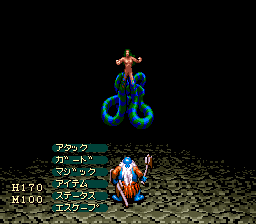
You know, I haven't really mentioned the gameplay yet. See, this game is basically Dragon Warrior, if Dragon Warrior tried to have what is commonly known as the Dark Souls mentality nowadays back then. This game is hard. That's the only thing that The 7th Saga is known for is it's difficulty. Even worse, it doesn't really matter what apprentice you choose to be your main, every other apprentice will be better than you. You picked Esuna to be your main character? Then Wilme will turn out to be a better mage. You picked Wilme to be your main? Valsu becomes a better tank. See, the enemy apprentices in the game retain their Japanese stat growths, but because the dev team asked for a way to artificially extend the game's length, they lowered the player's stats considerably and made the monsters stronger. Now that's not to say that the translation team wasn't totally without their mercy. There are a ton of items in the game that you can find in the international version that aren't in the Japanese version of the game. Not that it really matters. Even if you managed to find
every stat boosting seed in the game, the other apprentices will still run circles around you in terms of stats and even equipment, eventually winding up with equipment that they shouldn't have at that point. Another thing that the localization team did was increase how much experience and gold you get for winning battles against certain monsters, but every time you level up, so too do the enemy apprentices, and remember, they retain their Japanese stat growths, where every ten levels they gain +1 to each stat growth, which is why you should wait to hire one of the other apprentices, so they can get the Elnard bonuses. Makes the game somewhat easier. Another way to make the game easier is to hire one of the other apprentices, kill off your main for a while, and then go through a good portion of the game, because the other apprentices only scale with your
main character, not the ally apprentice.
 |
You will have to fight certain apprentices
throughout the game, although since one
is forced, his level won't scale. |
You continue onto Patrof and find that everyone is fearing for their lives because one of the apprentices has killed the King and all his soldiers because he was so cold-blooded. You decide to find out who it is because your crystal ball, not to mention the Elder of Guntz, said that a rune was in Patrof. Unfortunately, the game doesn't give you a break here (well, not totally a break) but the gate is locked, meaning you have to find a way to get into the castle. You reach the throne room, only to find that the one who killed the King is one of your fellow apprentices who now holds the Star Rune. Also, the apprentice is random, although for me it was Lejes. Also, the apprentice here is killed off for real after this, so make sure that you have an ally that you don't want to become the Patrof apprentice in your party. Killing that apprentice gets you the Star Rune which increases your defense in battle, and the people suggest that you go north to a city called Bone.
In Bone, you find people talking about a dinosaur and you meet a child who says that his uncle is waiting for him in Bonro. You tell him that he's in Bone, not Bonro, and depending on who you're main character is, he'll either give you a remote control or he'll ask you to take him to Bonro. Now, if you're Olvan, you don't have to talk to that kid at all, and can instead get a key from someone in town who will give you a key to the Tower of Grime, where you can find a teleportal to take you to the North, but only if you have Olvan somewhere in your party. It doesn't matter where he is, all that matters is that he's in the party.
After reaching the Northern side of the continent, the game becomes somewhat non-linear, and you can acquire the next three runes in any order you want. There are also a few small things you can do that don't have an effect on anything at all in the game.
Talking to the people in Telaine gets you information that the Sky Rune is in the town of Luze and a dragon still lives there. Going through a cave to the east of Telaine, you find Luze is in ruins and a dragon does indeed still live there. You kill it and find that the Sky Rune has been stolen from it's resting place and you have to track the thief down. That means you have to search through every single available city in the game, and they can even be in towns that you haven't been to yet. Have fun!
 |
| He is a powerful wizard indeed! |
The Light Rune is in a city called Bilthem, where the people are obsessed with their ruler, Doros. You decide to kill this man, as he has the Light Rune. However, to beat him, you'll need an object called the Star, which can destroy his illusions and force him to fight fair. Killing him nets you the aforementioned Light Rune and causes the people, or most of them anyway, to come to their senses.
The Moon Rune is held by a man by the name of Prosa. To get it, you have to kill a woman named Serpent whose child was unfairly taken away from her, so she kidnapped the children of other people so she could give her love to them. Such a sad way to go. Now, I'm not exactly sure what determines what causes Prosa to just fork over the Moon Rune, but I do know that if you don't ask for any rewards from anyone for defeating Serpent, then it'll be stolen from him by a man who was imprisoned long before the events of the game who you'll then have to bail out if you want to. You can just tell him you're going to pay the fine, but then ignore it entirely. Sadistic, isn't it?
Anyways, after getting those three runes, you go to the town of Brush and meet with the fortune teller Rarsha, who says that the last rune is on the continent to the West, but that a terrible power is in that land. Well, you have to get all the runes to beat the game, so you meet with Brantu again and he gives you Mecha-Glider to fly to the Western Continent to get the rune. Unfortunately, it isn't very stable and it crashes.
Going south, you enter a cave and just before exiting, you get cursed and can't use your magic anymore. You find a healer in the next town of Bugask who tells you to go to the town to the north, Guanta, and see if anything happens.
Reaching Guanta doesn't do squat, by the way. The Elder of the town says that he's one who placed the curse, but he can't remove it because he doesn't trust you. Going to the Western cave to get the Moonlight that Saro used to defeat Gorsia is a good test, the Elder says, and so you go there, and guess who you meet there!
 |
| Let it go already, man! |
Yep, none other than Pison, who has come back from the "Dark World" has Metal Pison, and he says that this time, he will win! Well, no he won't. Needless to say, he's a bit harder this time, considering that you have to fight him without your magical ability, and if you should have a party of nothing but spellcasters, then this battle is going to be a pain. Then again, what battle in this game
isn't a pain? Beating him has him spout a bunch of bullplop about how he can't wait to see how badly you've effed everyone, everywhere, and everything really good. He then finally passes away. I mean, the gall of this guy to come back not once, but twice after I killed him back near the start of the game! The
nerve of some people!!
Anyway, you get the Moonlight and take it back to Guanta and show it to him and he removes the curse. Going north, you find a cave that leads to a castle and is being guarded by a dragon. Beating him, you go into the castle and go through several repeating hallways until you've reached the third floor, where a demon named Gariso is waiting for you, and he has the Wizard Rune (God Ark in the Japanese version). Beating him gets you the Wizard Rune, but then Lemele shows up, breaks all the Arks and absorbs his power, stating that Lemele has been dead for five years and that he, Gorsia, was the one who trained you those five years. He then zaps you with lightning and says that he's coming for Saro.
You wake up in a village where you've apparently been asleep for an entire week straight. You then head out and find you're in a village you've never seen, been to, or heard of before. Going outside, the battle music has changed, which can only mean one thing: that you've been hurled into the distant past, which a character in a town that comes later confirms.
It's at this point of the game where a bit more of something actually resembling a story starts coming together, but it's still so bare-bones that it's not worth mentioning. You go through a bunch of towns, eventually getting to see Melenam in all it's original glory instead of the ruins you explored it as earlier in the game. Anyway, you deliver a message to a scientist from his mother, and then one of the Tetujins, Foma, goes crazy and tries to kill everyone in Melenam. Beating it shows that all of Melenam's energy was drained, causing it to sink into the sea.
 |
| Saro, we meet at last. |
You are told on the airship that Saro is a dark cavern someplace on this continent, but that his lifeforce is weakening. The higher-ups sent Tetujins out to look for Saro, but they're worried that the Tetujins might have trouble so they ask you to go and check on them. Reaching the town where Saro's disciples are staying, they tell you that Saro went to fight Gorsia alone, knowing full well that he wouldn't win this time, and that they were instructed to remain behind. Indeed, you find Saro in a cave where he says that he did indeed lose the fight, and asks you to finish what he started. He removes the curse on the runes and his disciples tell you how to use them, and in what order. Yeah, you have to use two of the runes in a specific order. Could've been worse, though.
After you've got the runes, you head to Gorsia's Castle, which is a strange building where if you take the wrong door, you're randomly placed back on one of the lower floors, or you just end up right back on the floor you were on to begin with. I hate buildings like this in video games. They don't add anything and it's pretty clear here that the only reason it's in the game to begin with is to pad out the game time.
 |
You're going to pay for tricking us the way
you did, Gorsia!! |
To beat Gorsia, you must first use the Wizard Rune to force him to show up. Now, in the international versions of The 7th Saga, as you can see from the screenshot on the left, he's blue. In the Japanese version, however, he's yellow. Afterwards, you must use the Light Rune on Gorsia to lower the magical barrier he has so that the other runes can affect him. Now, you don't have to use the other runes to beat him, but it's a lot harder without them. You can use the other five runes in any order you please, if you should choose to do so, just so long as you used the Wizard Rune first and the Light Rune second.
After beating Gorsia, he says that if he's going down, then he's taking you with him! He kills your main character on the spot with your ally, if you had one, still standing there. Gorsia says that he'll Saro again and goes into the future, whereas your character is given Saro's flesh and becomes King Lemele. That's right. You beat The 7th Saga, the hardest RPG on the Super Nintendo just to find out that Lemele is your character reincarnated. And then, credits. Super brief credits that show each of the apprentices battle stances as though you, the player, were fighting them.
I never mentioned the music. It has a few good songs, but not many, and it's especially odd when you consider it's the same guy who composed the soundtrack to Chrono Trigger, Yasunori Mitsuda! Well, he's one of the guys who composed Chrono Trigger's soundtrack, anyway, the other being Final Fantasy veteran composer Nobuo Uematsu.
Graphics-wise, the game looks decent, and all the movement animations in the game move rather fluidly. You can tell what everything is, and the battles can go blazingly fast, at least once you're characters have hit a high-enough level, which you're going to have to do and
even then, the monsters can still beat you in just one or two attacks.
Even back then, even as a child, I knew something was off about The 7th Saga. I knew there was a serious problem with the game's difficulty, and it wasn't until later, much later that I discovered why the game's difficulty was so off-putting. You see, the game's dev team asked the translation/localization team to try to find a way to artificially extend the game's length. Their solution? Lower the stat gains the main character gets at level up and strengthen enemies, but leave the other apprentices alone. Couldn't they have found a better way to pad out the game time than that? I mean, I know they had limited cartridge space, but still, man! As ProJared said about Drake of the 99 Dragons, if you should see this game in a store somewhere, I urge you, don't pick it up, don't go near it, don't even look at it out of morbid curiousity. If you absolutely must play The 7th Saga, then get a ROM and an Emulator, because the speed up button will be your best friend. It can also help by allowing you to use Game Genie Codes. And no, I won't help you find the ROM, either. It's illegal. Or better yet, get a ROM Hack of the game to patch over the ROM that gives the enemy apprentices the same growth rates the player has, that takes away the Elnard stat boosts.
It sucks that this game sucks so much, because when you really get down and examine it, it has a serious Dungeons & Dragons feel to it, or at least the player characters do, and I even played Dungeons & Dragons video games with these characters names in them, but that doesn't mean I'm excusing this game for God-awful design decisions. The game's concepts could've worked, and even the dev team knew this, as depending on which character you choose, you have to take a slight detour in the game, and Olvan is the only character who gets his own little path in the game at one point.
I give this game a 1/10. Avoid at all costs!!
This review, along with all text and screenshots, is © 2019 Jestan Diams™. Jestan Diams, Jestan Diams' Magical Tome of Games, and all other associated names are trademarks of Jestan Diams. All other rights are copyright or trademarks or registered trademarks of their respective owners. All rights reserved.